

Let me tell you about a conversation we have had more times than we can count.
A company reaches out in September. They want to take 80 people to Goa in December. Leadership has already mentioned it to the team. Someone has informally floated a budget of 25 lakhs. They want us to make it happen.
We take a breath. We ask a few questions. And then we gently explain that an 80-person offsite in Goa during peak season, done properly, does not cost 25 lakhs. It costs two to three times that, depending on the choices made.
There is a long silence on the other end of the call.
This is not a rare conversation. It happens because nobody in the corporate events industry publishes honest numbers. Vendors quote low to win the business and adjust later. Clients google "Goa offsite cost" and find articles that are either outdated, vague, or written by someone who has never actually managed a 300-person event on the ground.
We are going to fix that today.
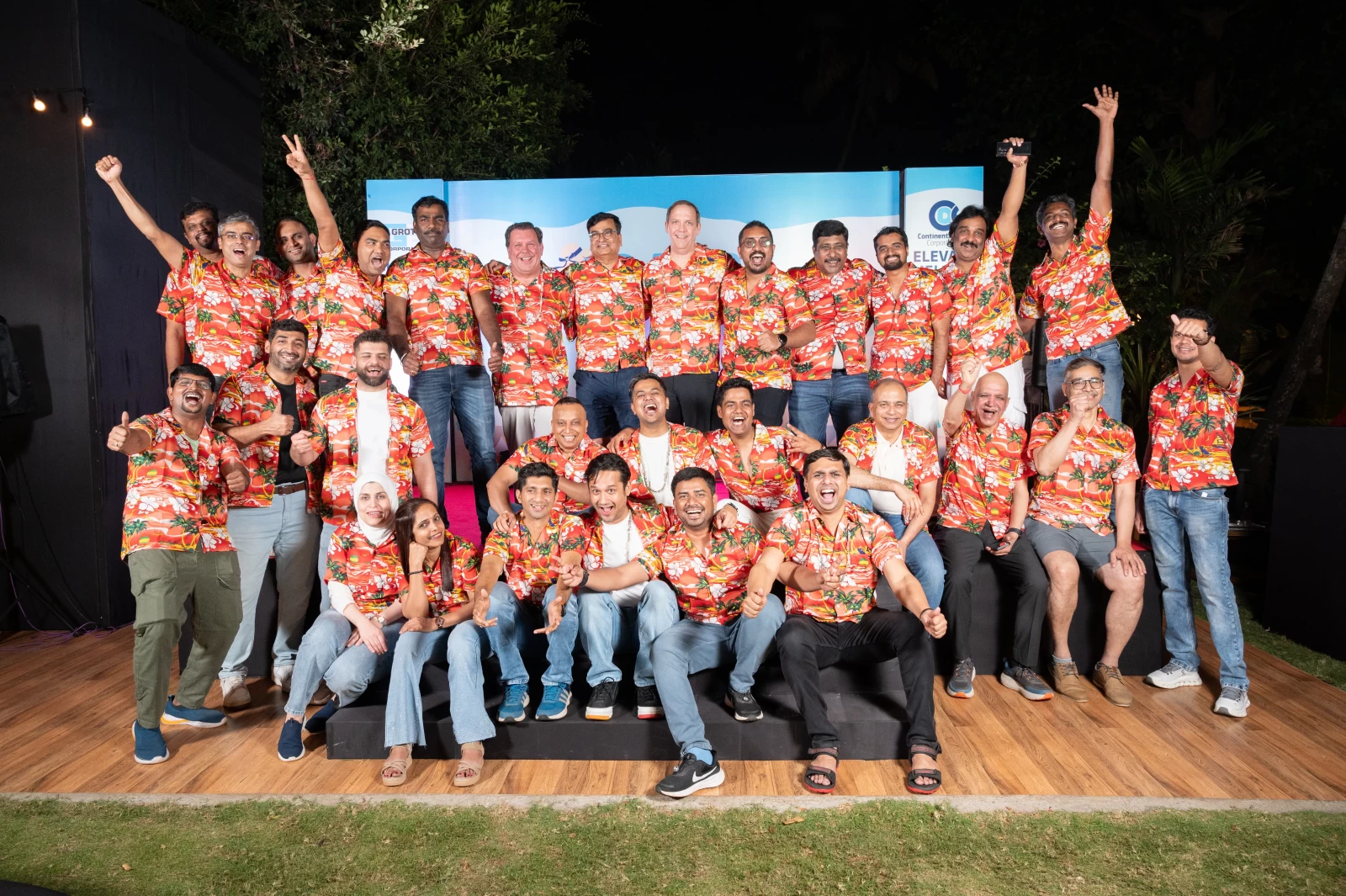
SOS Party has planned and executed corporate offsites in Goa for groups ranging from 20 to 500 people across multiple seasons, hotel categories, and budget levels. We have negotiated room blocks during Diwali week, managed F&B across outdoor beach dinners and formal banquet halls, and delivered entertainment programmes that required four separate music licences before a single artist could take the stage.
We know what things cost. We know where budgets go wrong. And we believe that the companies that plan with honest numbers make better decisions, have better events, and do not end up in that uncomfortable conversation with their finance team three weeks before departure.
So here is the full picture.
Before Any Number Makes Sense, You Need to Understand Season
If there is one thing to take from this entire blog, it is this: the cost of a corporate offsite in Goa is not a single number. It is a range that shifts significantly depending on when you go. Get the season wrong in your planning, and every other number in your budget is built on a false foundation.
Goa operates across three distinct pricing realities for corporate events.
Off season runs broadly from May through September. This is Goa during the monsoon. The landscape turns an extraordinary green, the beaches are quiet, and hotels that were turning away inquiries in December are now genuinely motivated to fill their rooms. Off season used to mean dramatically lower rates, and it still does relative to peak. But off late, the gap has been narrowing. Tourist influx into Goa has continued to grow year on year, and hotels have adjusted their off season pricing upward accordingly. The deals are still real. Just do not assume the off season rates of three years ago are still the baseline.
Regular season covers roughly October through early November and February through April. This is Goa at a comfortable pace. Good weather, reasonable availability, and pricing that reflects a market in balance rather than one under pressure. For most companies that have flexibility on dates, regular season is where the best value lives.
Peak season runs from November through January. This is the Goa that everyone wants. It is also the Goa where rooms book up months in advance, where hotels know they have leverage, and where every cost in this breakdown climbs by a margin that surprises people who have only ever booked a personal holiday.
We had a client a couple of years ago, a fast-growing technology company, who had their heart set on a December offsite in Goa. When we showed them what their preferred property would cost in December versus the same property in February, the numbers were so different that they moved the event by six weeks. Same venue. Same agenda. Same team. Forty percent less in total cost. That is the season variable at work.
Now, with that context in place, here are the numbers.
What Venue and Accommodation Actually Cost in Goa
Accommodation is the largest single line item in any Goa offsite budget. It is also the one that catches people most off guard, partly because hotel websites are deliberately opaque about corporate group pricing and partly because the seasonal variation is so significant.
For corporate offsite planning purposes, Goa's hotels fall into two meaningful categories.
Four-star properties in Goa are priced at roughly 7,000 to 10,000 per person per night on double occupancy with breakfast included, during off season. In regular season, add approximately 3,000 per person to that range. In peak season, particularly November through January, add 6,000 to 10,000 per person on top of the regular season rate.
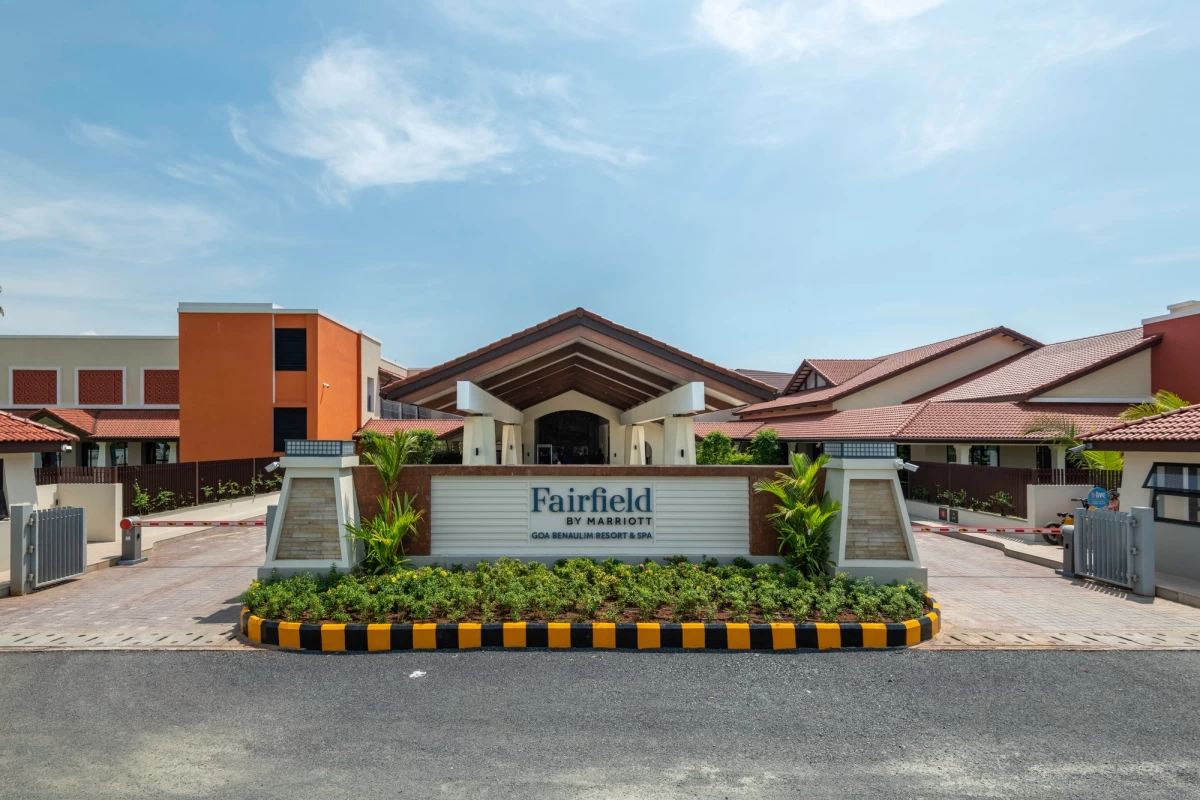
To make that concrete: a 200-person group at a four-star property in regular season, staying two nights, is looking at accommodation and breakfast costs somewhere between 80 lakhs and 1 crore.
Five-star properties start at 10,000 to 15,000 per person per night on double occupancy with breakfast, during off season. Apply the same seasonal increments. At a five-star property in peak season, a 200-person group across two nights can cross 1.2 crore.
There are a few things worth knowing before you start venue negotiations that most guides do not cover.
Room count matters as much as nightly rate. A hotel that offers an attractive per-night cost but cannot accommodate your full group within its own inventory creates an overflow situation where a portion of your delegates stay at a second property. This sounds manageable until you are coordinating shuttle runs between two hotels at 7 AM on day one while simultaneously trying to manage check-in, welcome kits, and the opening session. We have managed this situation for clients who booked themselves. It is fixable but it adds friction that does not need to be there.
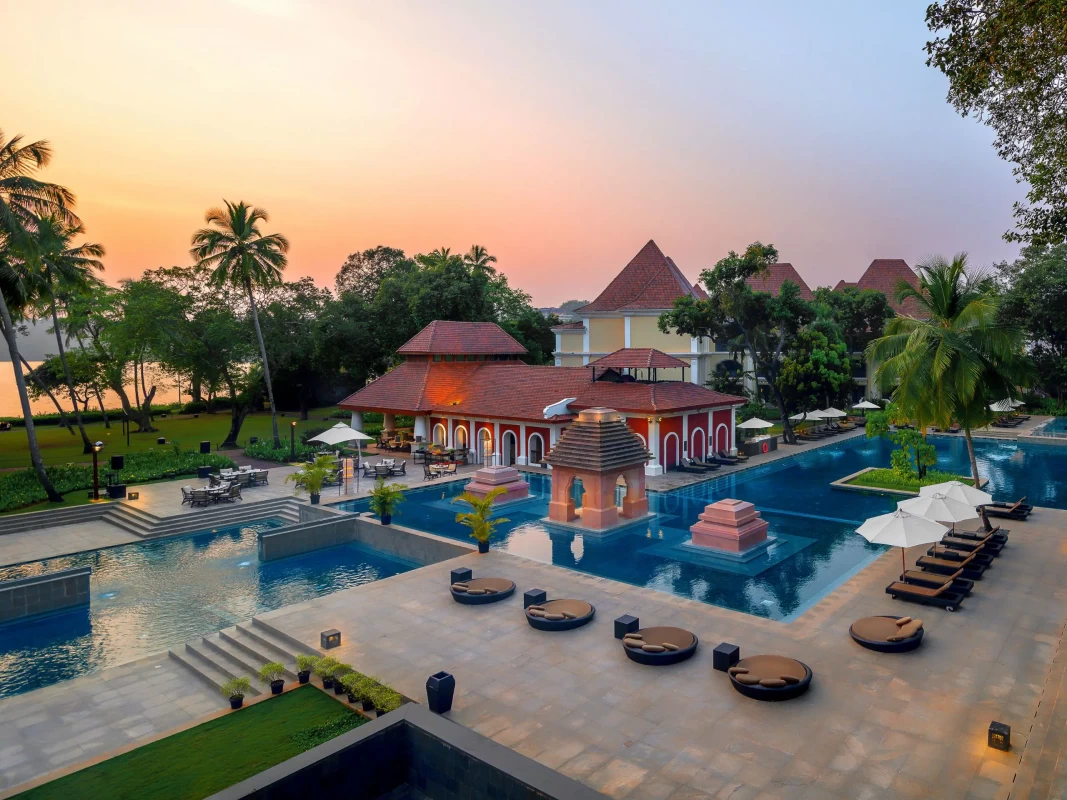
Banquet and conference space is a separate negotiation from the room block. Some hotels will include venue hire as part of the room commitment, particularly for large groups. Others treat it as an independent revenue line. Always negotiate these together and get the banquet terms in writing before the room contract is signed.
The venue is also not just about the room. One of our clients, a pharmaceutical company planning their national sales conference, chose a particular property in North Goa primarily on the basis of a low per-room rate. What they had not fully evaluated was the banquet hall, which was too small for their plenary sessions without a complicated room flip between sessions, and the outdoor areas, which did not suit the gala night they had in mind. They made it work, but the constraints shaped the event in ways that a slightly different venue would not have. Venue selection is a holistic decision, not a rate negotiation.
Food and Beverage — The Line Item That Grows in the Dark
F&B is where Goa offsite budgets quietly expand if they are not planned with precision from the beginning. Most hotels in Goa price F&B for corporate groups on actual consumption, meaning you pay for what your delegates eat and drink rather than a fixed per-head package. This feels like the lower-risk option, and for groups where consumption patterns are predictable, it often is. For groups that include heavy social drinkers, open bar situations, or evening programmes that run longer than planned, actual consumption can produce some genuinely startling line items.
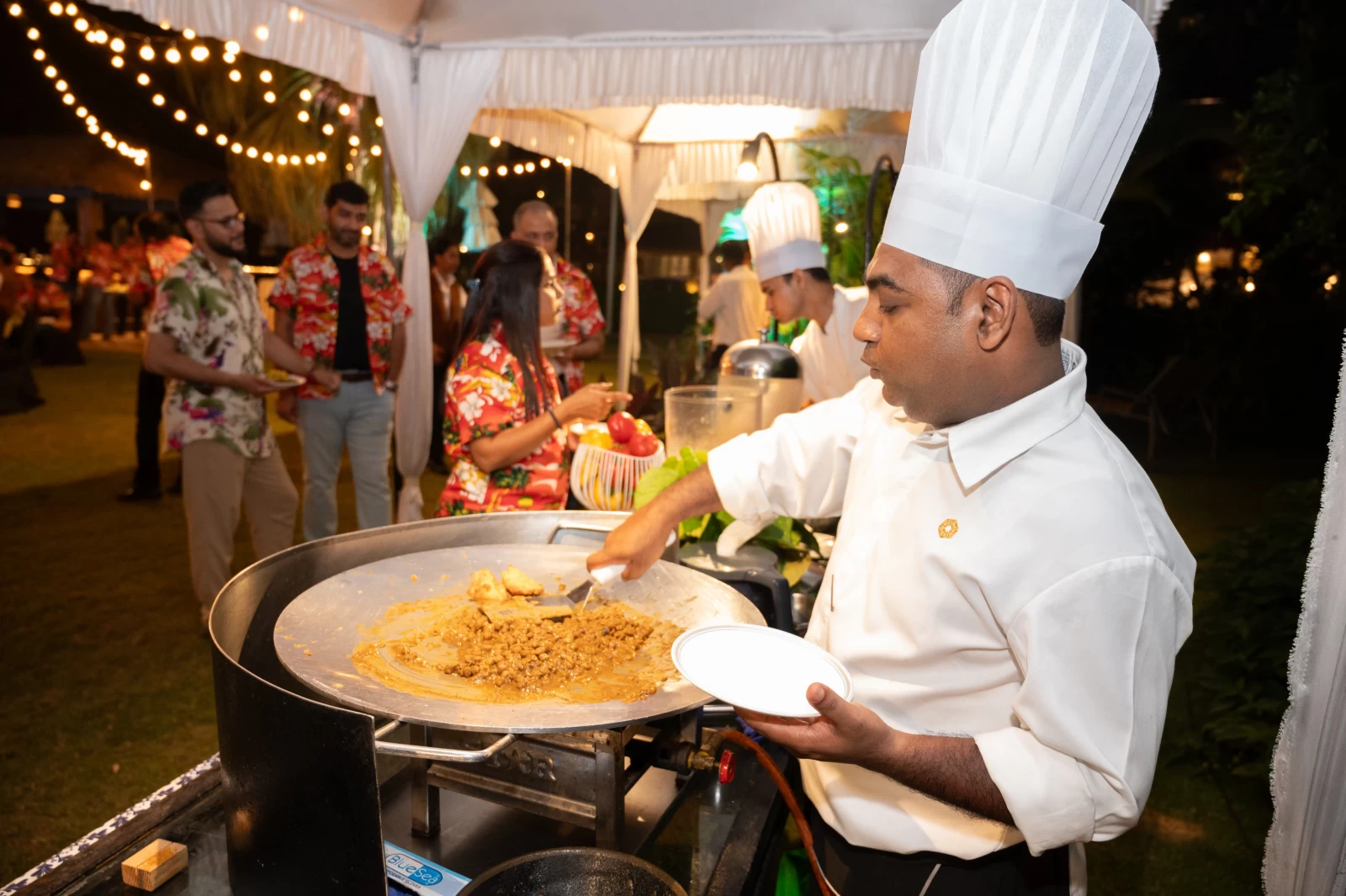
For those who prefer the predictability of a package, here is what the market looks like.
Lunch for a corporate group starts at around 2,000 per person and goes up to 2,800 per person, depending on the menu, the venue setup, and whether you are in a standard banquet hall or a more curated setting. Dinner starts at 2,500 per person for a straightforward banquet dinner and can reach 5,000 per person or beyond when you move into curated outdoor experiences, chef-driven menus, or venues that lean into Goa's strengths. A private dinner at a heritage property with fresh seafood and a live kitchen setup is a different experience and a different cost than a hotel banquet. Both are valid choices. They are not the same choice.
Starters are sometimes included in meal packages. When they are not, budget an additional 1,200 to 1,800 per person for a rotation service of two vegetarian and two non-vegetarian options, typically served over 90 minutes to two hours. This is the standard corporate cocktail format and it moves faster than you expect when 200 people are hungry after a full day of sessions.
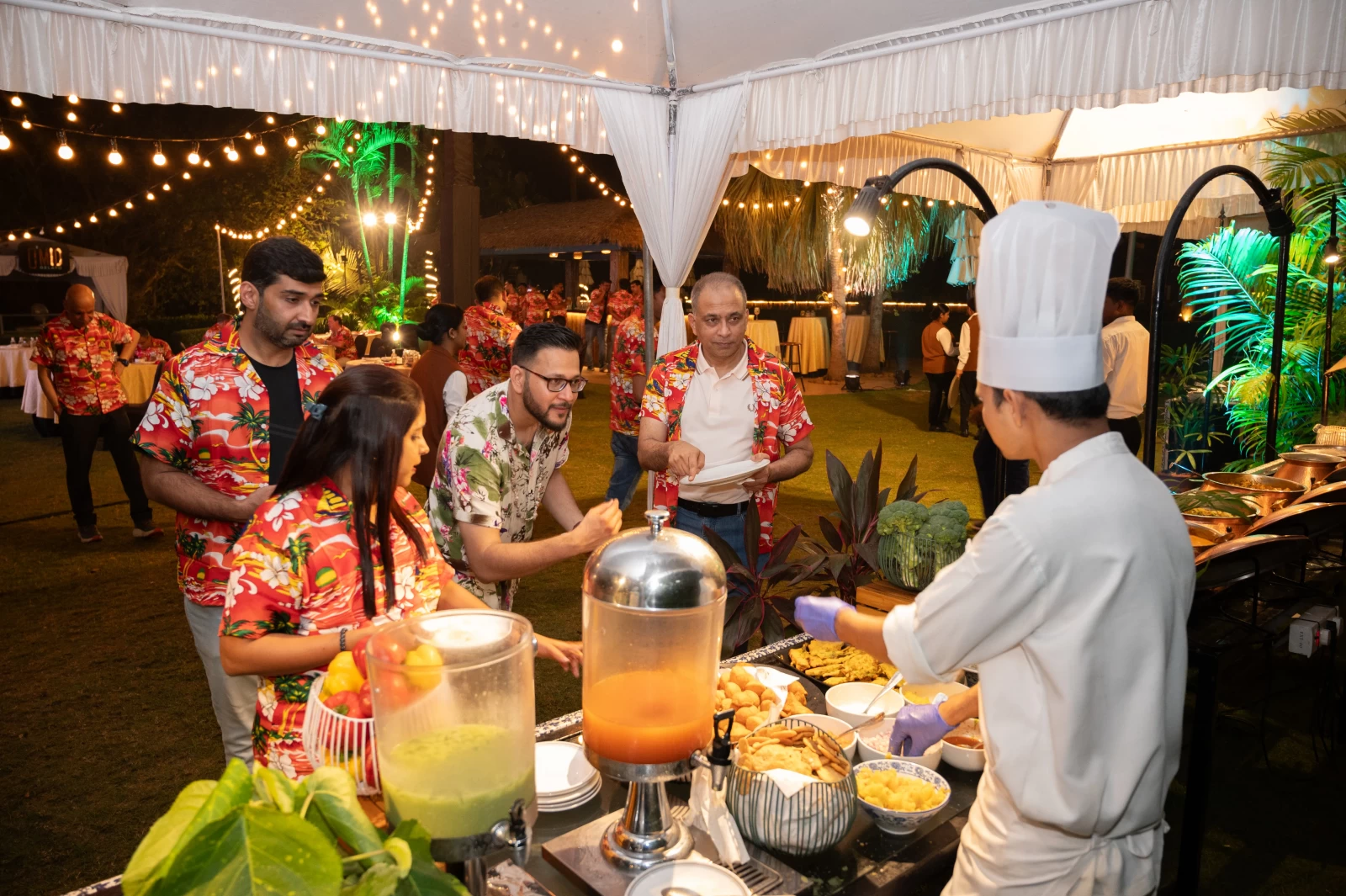
F&B packages, when taken as a full-day offering, run from approximately 2,500 plus taxes at the entry level to 5,500 plus taxes per person for a two-hour package.
We want to say something directly about the outdoor dinner in Goa, because this is where some of the most meaningful budget decisions happen. A gala dinner on a resort lawn or a beachside venue in Goa is genuinely one of the best things a company can do for a corporate offsite. The setting does something to a group that a banquet hall simply cannot replicate. People relax differently. Conversations go deeper. The evening feels like an event rather than a meal. The additional cost, relative to a standard banquet dinner, is real but it is also the element that delegates talk about on the flight home. We have never had a client tell us the outdoor dinner was not worth it.
Getting 50 or 300 People to Goa — The Travel Reality
Travel costs for a corporate offsite in Goa vary more than almost any other line item, primarily because they depend on where your delegates are coming from, how much lead time you have, and decisions about commercial versus charter travel that have significant downstream implications.
Commercial flights are the primary mode of travel for most corporate groups heading to Goa. The economics are straightforward when planned with sufficient lead time. A return ticket from Mumbai or Bangalore or Hyderabad, booked approximately three months in advance, sits at roughly 10,000 to 12,000 per person. Delhi adds a few thousand to that range, settling at around 16,000 to 18,000 return with reasonable advance booking.
For a 200-person group from Bangalore, flights booked three months out represent approximately 30 lakhs in travel costs before a single rupee has been spent in Goa.
Book late, and these numbers shift meaningfully. Goa routes fill up, particularly on weekends and through peak season. Companies that start flight coordination at six weeks out frequently pay 40 to 60 percent more per ticket than companies that locked travel at the three-month mark. We have seen this happen. It is painful and entirely avoidable.
Charter flights become relevant for larger groups where schedule control matters. A 120-seater aircraft from Bangalore to Goa starts at approximately 20 to 25 lakhs one way. For a 250-person group, that is three aircraft and a one-way travel cost of 40 to 50 lakhs. The advantage of charter is complete control over departure times, a unified group experience from the moment everyone boards, and significantly simpler logistics on both ends. The disadvantage is the upfront cost and the lead time required. Charter is not a solution for companies that start planning eight weeks before the event.
Airport transfers in Goa are the single most consistently underestimated line item we encounter. We say this having watched it happen with clients who are otherwise very diligent planners.
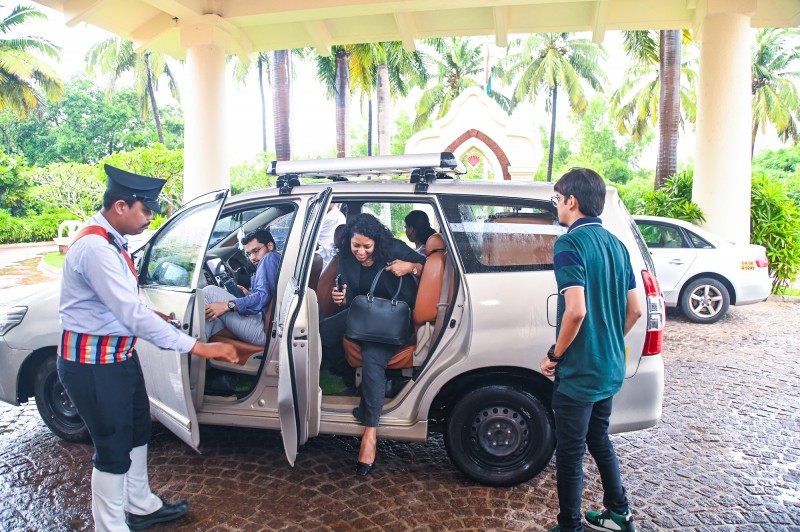
Goa has two airports. Dabolim in South Goa and Mopa in North Goa. Depending on which airport your flights arrive into and where your venue is located, transfer distances can be substantial. A cab from either airport to a resort in North or South Goa runs 2,500 to 3,500 per cab one way. For individual or small group arrivals spread across multiple flights over several hours, this adds up quickly and in ways that are hard to predict precisely in advance.
For larger group transfers, a traveller vehicle moving 12 to 15 people costs 15,000 to 20,000 one way. For a 200-person group requiring 15 traveller vehicles for airport pickup, the transfer cost alone is 2.25 to 3 lakhs one way, or 4.5 to 6 lakhs return.
This number almost never appears correctly in initial budget estimates. It feels like a small operational detail early in the planning process. On the actual cost sheet, it is a significant line item that surprises people every time they see it for the first time.
Production — What It Takes to Make a Space Feel Like an Event
Production is where the visible and felt quality of your offsite is established. It is the first thing your delegates experience when they walk into the conference room on day one and the last thing they experience as they leave the gala night. It is also the line item where companies most frequently attempt to save money and most consistently regret the decision.

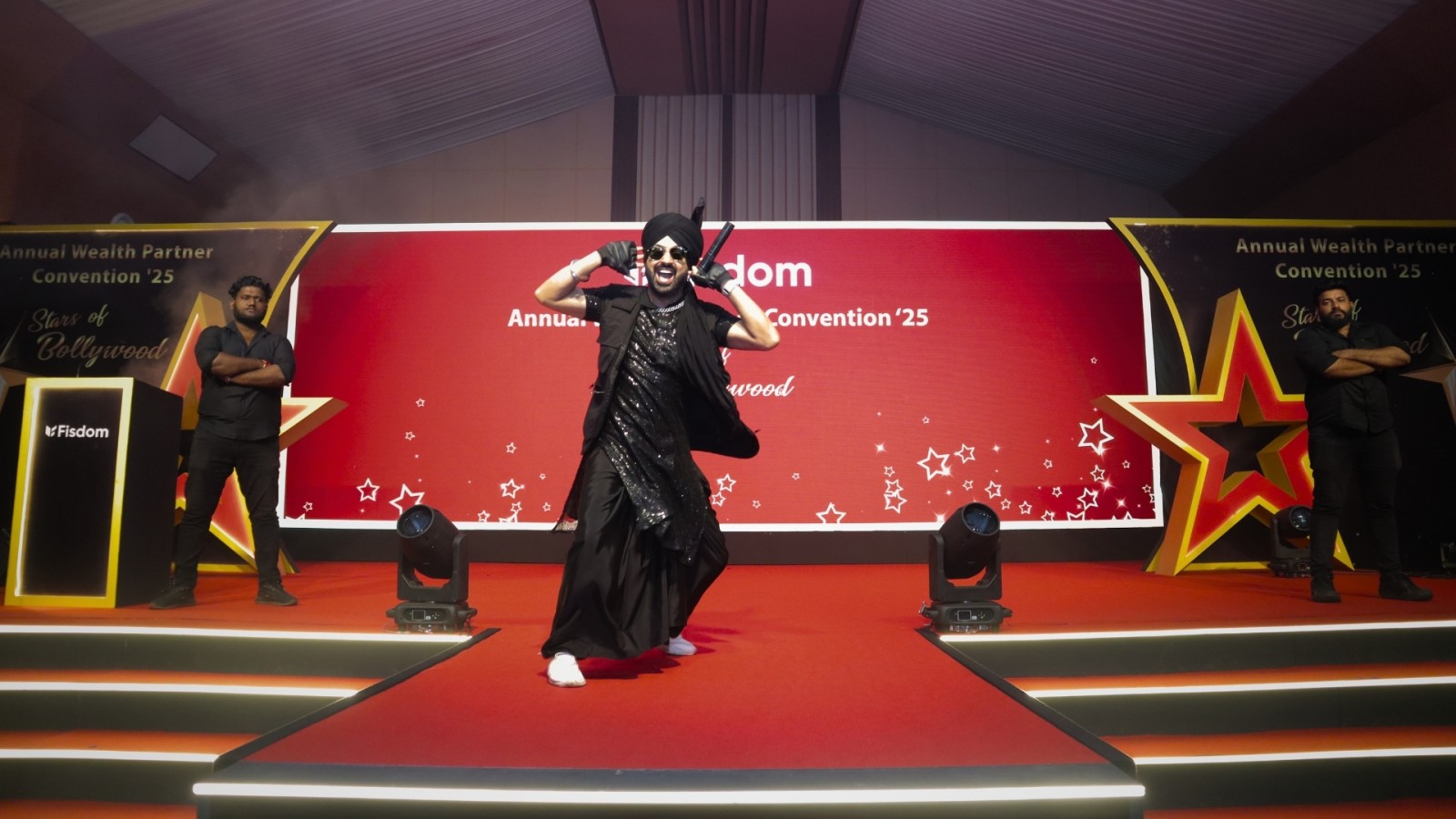
For a two-day corporate event with a conference format — a main stage, LED screen, PA system, and functional lighting — a working production budget in Goa starts at around 4 to 5 lakhs. This delivers a professional, clean setup. Your presentations look sharp, the audio is clear, and the room does not feel bare. For events where the agenda is the experience and the setting is secondary, this is a reasonable foundation.
For a two-day event that includes a proper gala night with meaningful production, budget 8 to 12 lakhs depending on the scale, the complexity of the design, and the degree of customisation involved. Custom fabrication, atmospheric lighting design, multi-zone AV, and stage elements that reflect the event theme all sit within this range and above it depending on what is being built.
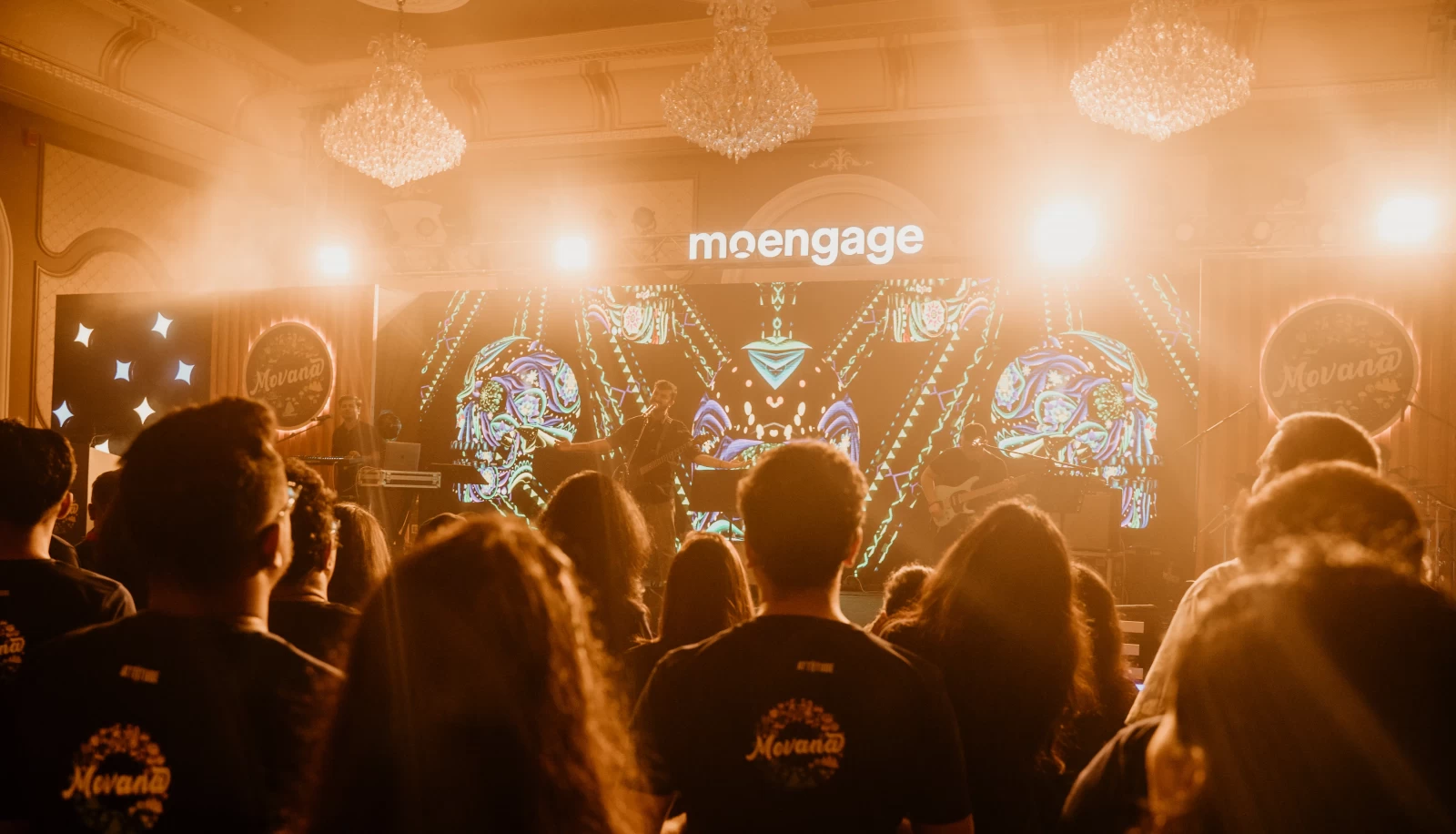
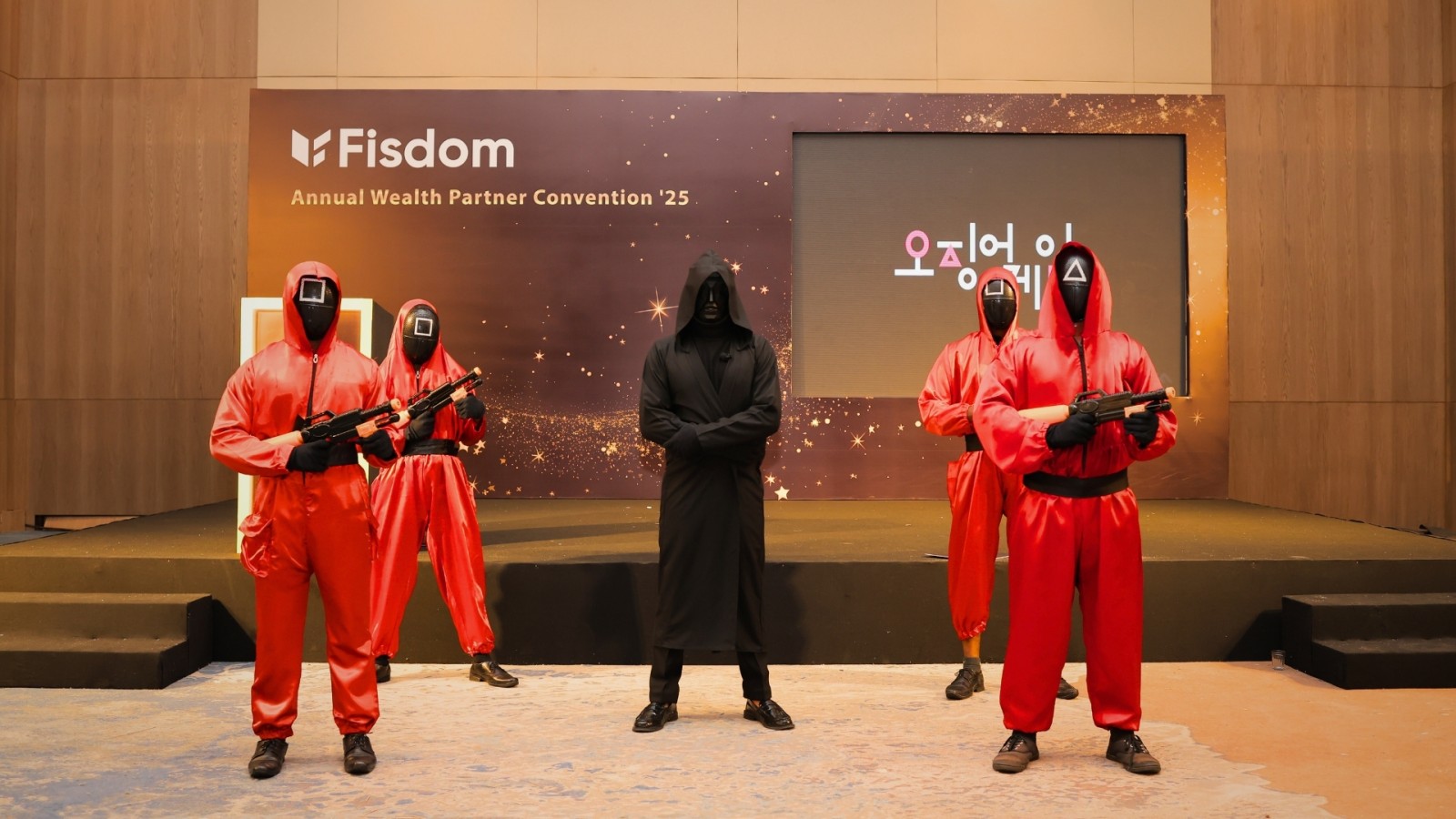
For the gala night as a standalone production element, most companies working with SOS Party factor 6 to 10 lakhs. This covers a well-designed stage, lighting that transforms the space into something that feels genuinely different from where they spent the day, and AV that handles both the entertainment programme and any awards or speeches cleanly.
One thing worth understanding about production in Goa specifically: it is not Mumbai. Goa has a vendor ecosystem for events, but it is smaller and less deep than what is available in the major metro markets. For custom fabrication work, material often needs to be transported from the mainland, which adds both cost and planning time. Companies that build Goa production budgets based on what they have spent in Mumbai or Bangalore for similar setups sometimes find the numbers do not translate directly.
Entertainment — The Part Where Licences Enter the Conversation
Entertainment at a corporate offsite in Goa is where many planners encounter a cost category they had genuinely never thought about before: music licences.
In India, any event where music is performed or played commercially requires licences from the relevant rights bodies. IPRS, PPL, Novex, and RMPL are the primary ones, and the specific combination required depends on the hotel category, the number of attendees, and whether the event is indoors or outdoors. These are not optional. Reputable venues will require them before an entertainment programme can proceed, and the cost varies based on the same parameters. This is not a bureaucratic inconvenience. It is a real line item that needs to be in the budget from the beginning.
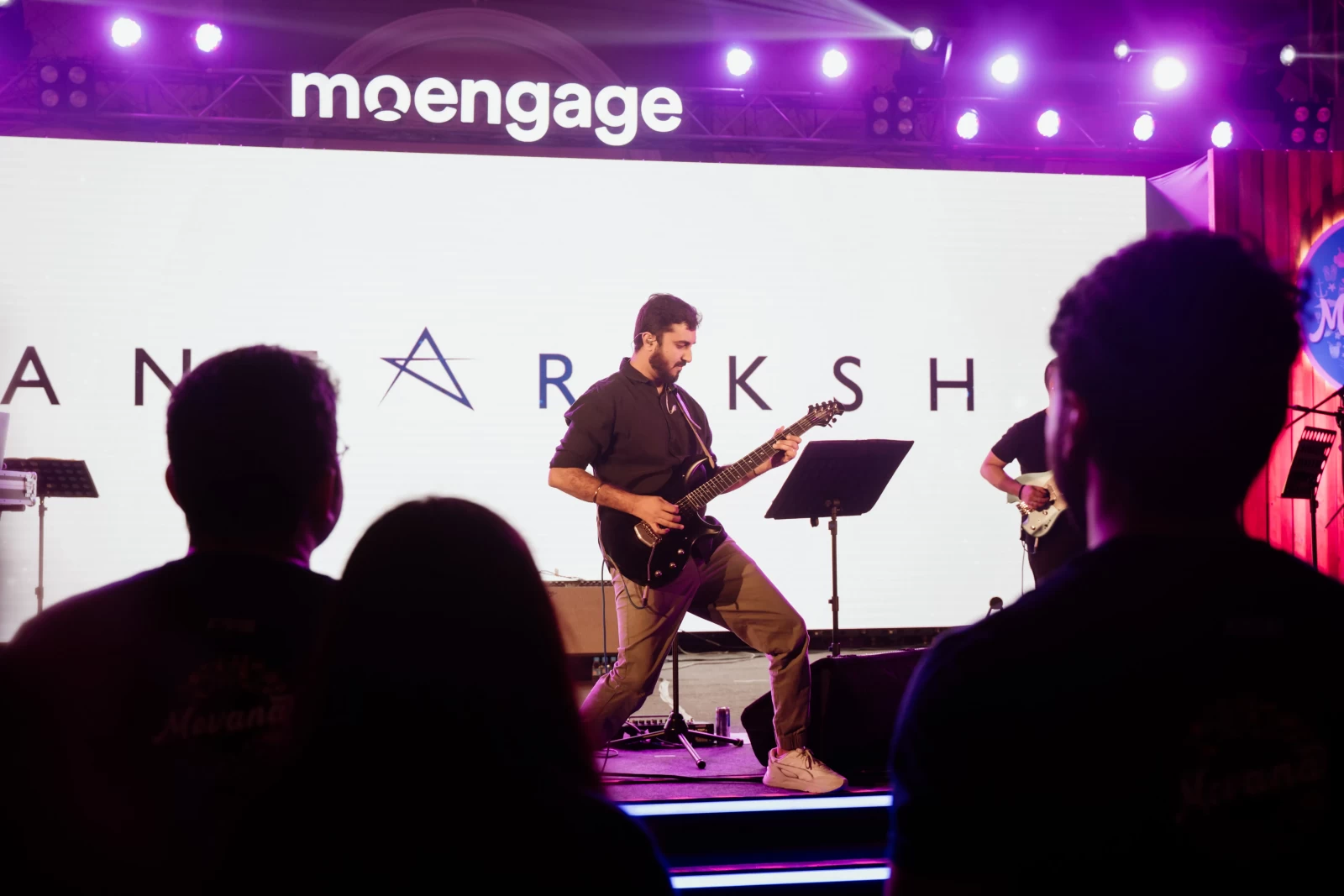
We once worked with a client who had done their own venue booking and negotiated an entertainment programme directly with an artist. They arrived at the venue to find that the licence costs, which nobody had discussed with them, added a meaningful amount to what they had budgeted for entertainment. They paid it because they had no alternative. It was a lesson we could have helped them avoid.
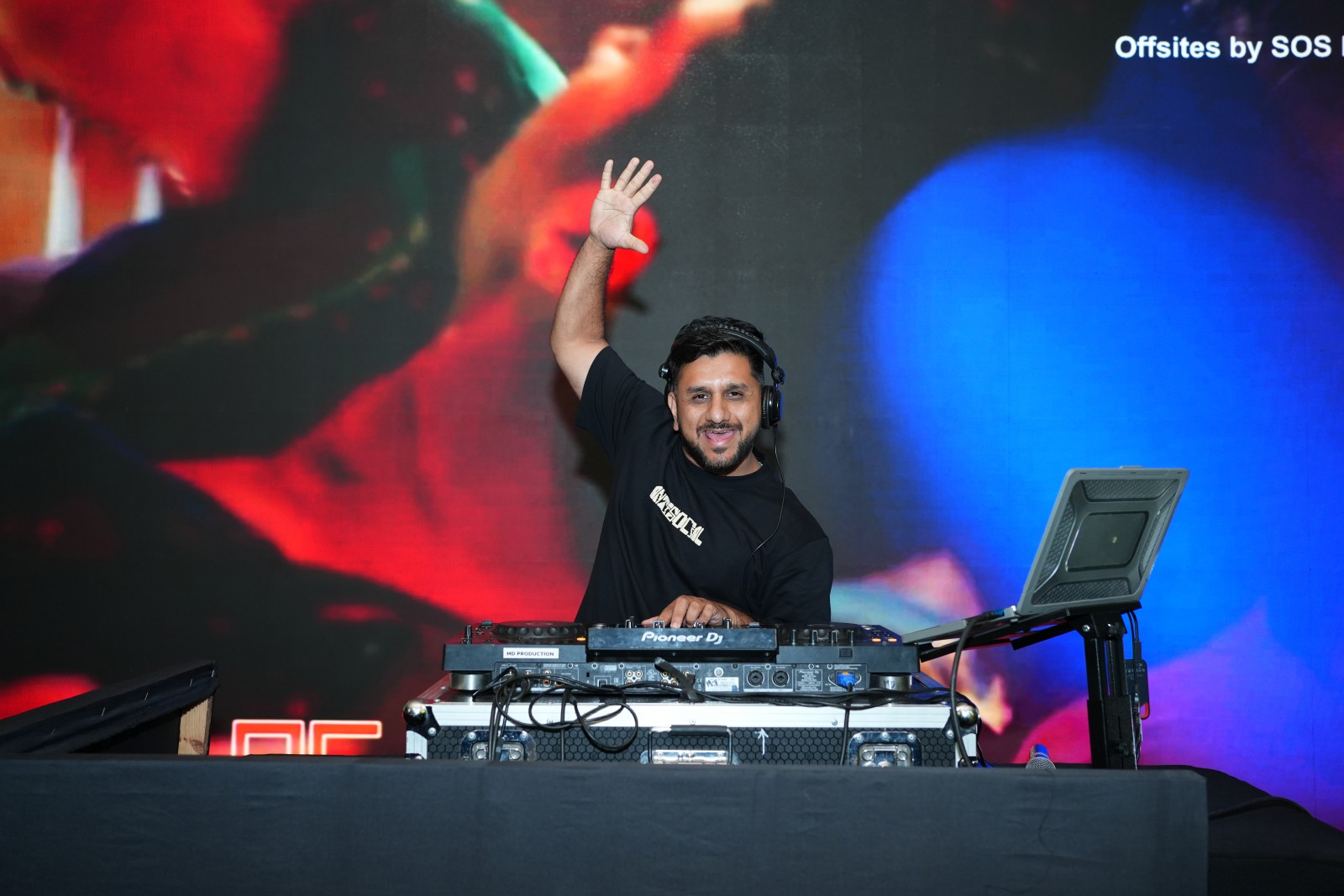
With licences included, a well-produced entertainment programme for a corporate gala night in Goa, covering a headline act or artist and a DJ, typically runs 5 to 10 lakhs depending on the calibre of the artists and the duration of the programme. This range covers mid-tier to premium corporate entertainment, not a celebrity performance, which sits in a different budget category entirely.
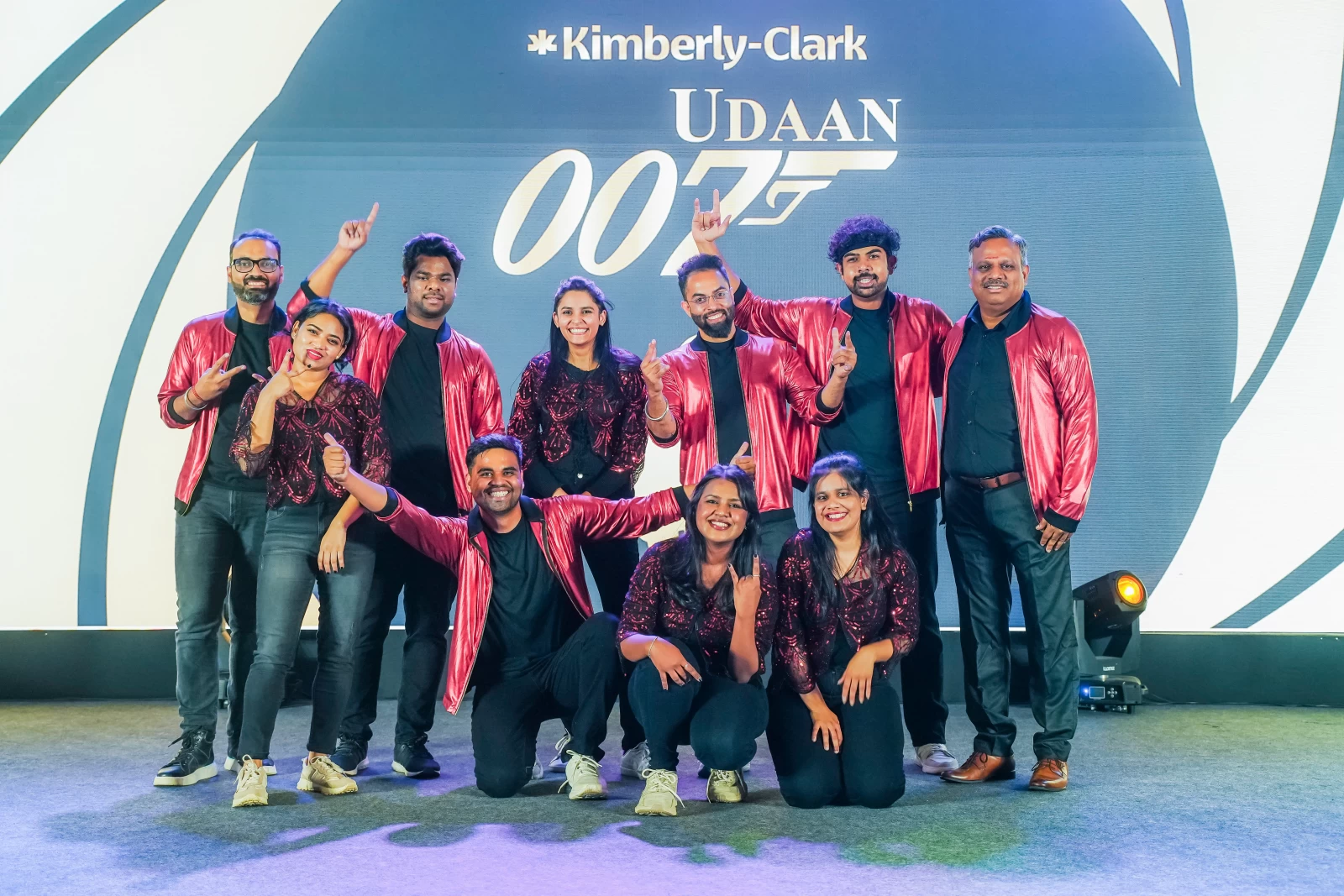
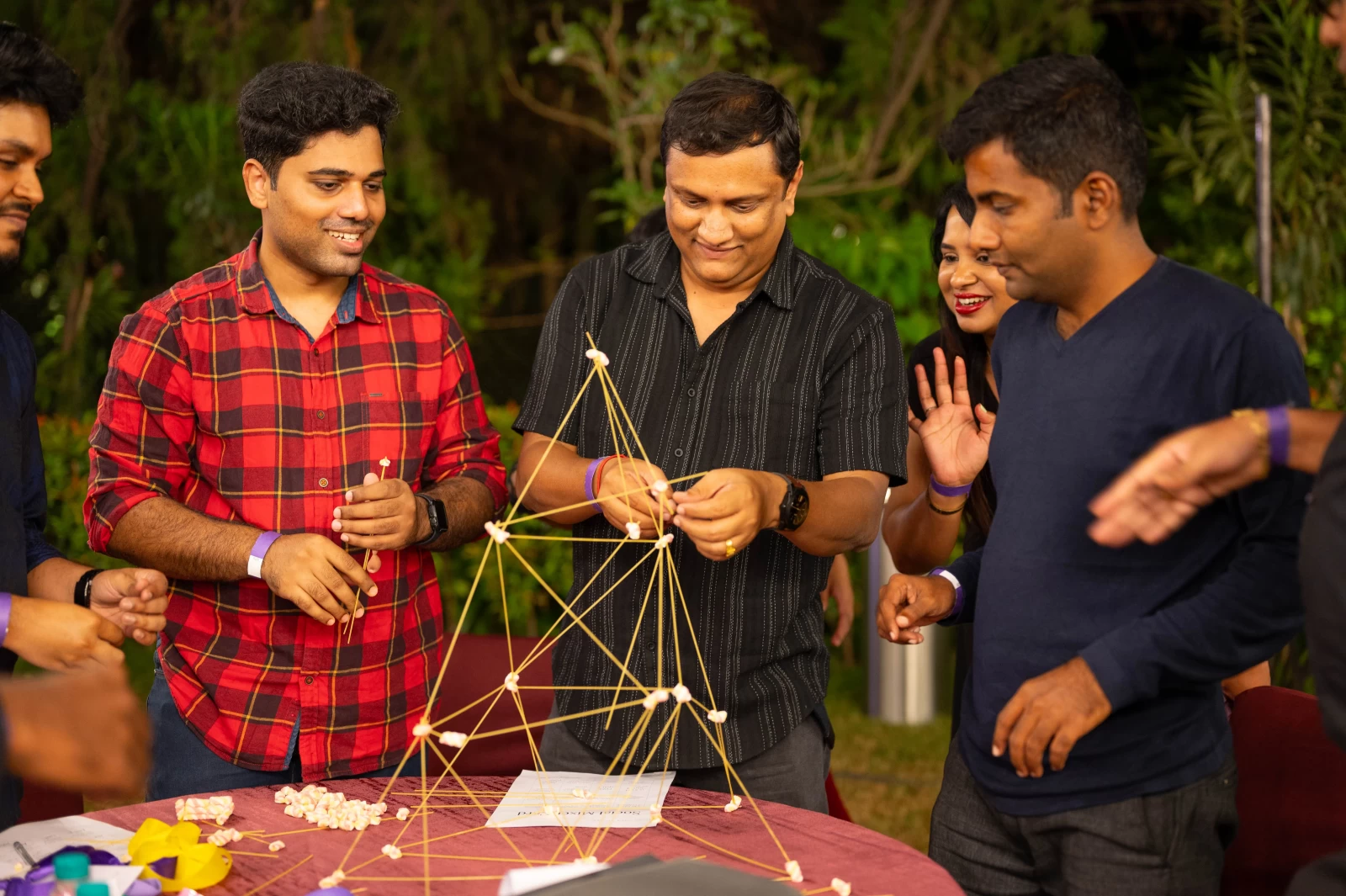
Team building activities deserve their own mention because they are increasingly a core part of how companies think about corporate offsites rather than an add-on. A well-designed team building programme in Goa, with a facilitator, props, a clear theme, and proper on-ground event management, costs approximately 1.5 to 3.5 lakhs depending on the number of participants and the complexity of the activity design. The range reflects real differences in quality and experience, not just scale.
The Four Costs That Blow Most Budgets
In our experience, four specific categories account for the majority of budget overruns on Goa corporate offsites. Not because they are impossible to plan for, but because they are consistently underestimated or omitted from initial estimates.
Airport transfers are the most frequent offender and have been covered in detail above. The per-vehicle cost looks manageable in isolation. Across a large group with staggered arrivals across two airports over multiple hours, it compounds into a significant number that surprises almost every first-time Goa event planner.
Production is where the impulse to trim budget has the most visible consequences. The production quality is what your delegates see and feel for the entire event. A production budget that is too tight either shows clearly on the day, in ways that reflect on the company, or requires the event company to quietly cut elements to stay within the number. Neither outcome serves the event or the company's objectives.
Entertainment and licences together are consistently underestimated, partly because the licence requirement is not common knowledge outside the industry and partly because the cost of quality entertainment that suits a corporate context is higher than most companies assume based on personal experience of hiring entertainment for smaller social events.
Team building is almost always added to the programme as an afterthought and budgeted accordingly. A team building activity that is well-designed and well-facilitated is one of the highest-value hours in a corporate offsite, particularly for teams that do not often spend time together outside of work. A cheap, perfunctory activity that clearly exists to fill a time slot does the opposite of what team building is supposed to do. It is worth budgeting for properly from the beginning.
The Most Expensive Mistake Is Not a Budget Line at All
Everything above is navigable with the right planning and the right partners. But the single most expensive mistake companies make when planning a Goa offsite has nothing to do with any individual cost category.
It is starting too late and trying to manage the whole thing themselves.
Goa's best properties for large corporate events book up. Peak season dates at premium venues are sometimes committed twelve months in advance for groups of 200 people and above. Companies that start the conversation in September for a December event are already working with a constrained set of options. The venue they wanted may not be available. The dates that work for the business may no longer work for the property. And every decision made from that point carries the cost of reduced leverage and limited alternatives.
The second part of the mistake is the belief that once the hotel contract is signed, the rest can be managed internally. A corporate offsite in Goa involves a hotel, a banquet team, a flights coordinator, an airport transfers company, a production vendor, a fabricator, an entertainment agency, a licencing process, a team building company, a photography and videography crew, and a participant communications process that needs to run clearly across all of it. Each of these partners has their own timelines, their own requirements, and their own way of communicating. Managing eight to ten vendor relationships alongside your actual job, while also trying to build an agenda and brief your leadership team, is how details get missed and costs escalate.
The companies that have the best Goa offsites are not the ones with the largest budgets. They are the ones that brought in an event management partner early, gave them a clear brief, and trusted them to own the complexity so that they did not have to.
Putting It All Together — Broad Budget Ranges by Group Size
These are honest directional ranges for a two-day, one-night Goa offsite in regular season. They are not quotes and they are not guarantees. They are the kind of numbers that should be in the room when a budget is first being discussed, so that the conversation starts in the right territory.
40 to 100 people: A well-produced offsite at a four-star property, inclusive of accommodation with breakfast, F&B across two days, production, transfers, and a solid entertainment programme, broadly sits in the range of 35 to 65 lakhs in regular season. The range reflects the real choices available at this group size.
100 to 300 people: At this scale, at a four-star property with a proper gala night and full production, budget broadly between 65 lakhs and 1.5 crore. At a five-star property with premium entertainment, curated outdoor dining, and high-quality production, the ceiling moves upward from there.
300 to 500 people: You are now working with the largest properties in Goa, charter flights become worth a serious evaluation, and production scales accordingly. A well-executed offsite at this size in regular season sits broadly in the range of 1.75 crore to 3.5 crore, with meaningful variation depending on the choices made at every stage.
Peak season adds significantly to all of these ranges. Off season creates room to invest more in experience within a given budget.
A Note on Why We Are Writing This
The corporate events industry in India does not have a culture of publishing honest numbers. Most agencies quote what wins the brief and manage the reality later. Most venues are opaque about group pricing until you are deep into a conversation and have already invested time and expectation.
We think this is the wrong approach. Not just for clients, but for the industry.
The companies that plan with honest numbers make better events. They make more informed decisions about destination, season, hotel category, and experience design. They do not have to compromise on the things that matter most because they ran out of budget at the wrong moment. And they trust their event management partner more, because that partner told them the truth from the beginning.
If you are planning a corporate offsite in Goa and you want to understand what your specific brief will actually cost before you commit to anything, talk to the SOS Party team. We will give you a real answer.
Contact SOS Party — Start Planning Your Goa Offsite



 Tailored for teams
 Hassle free booking
 Dedicated event planner